The Men's Accessories Cheat Sheet: Belts, Watches, and Everything Else You're Overthinking
Most men own accessories they've never really chosen. A belt that came with a pair of pants. A watch someone gifted them years ago. Shoes that were on sale. The result is a drawer of stuff that doesn't go together, worn more or less at random.
You probably don't need to buy new things. You need to understand a few rules about how accessories work with clothes, then look at what you already have with fresh eyes.
The one rule that covers most of it
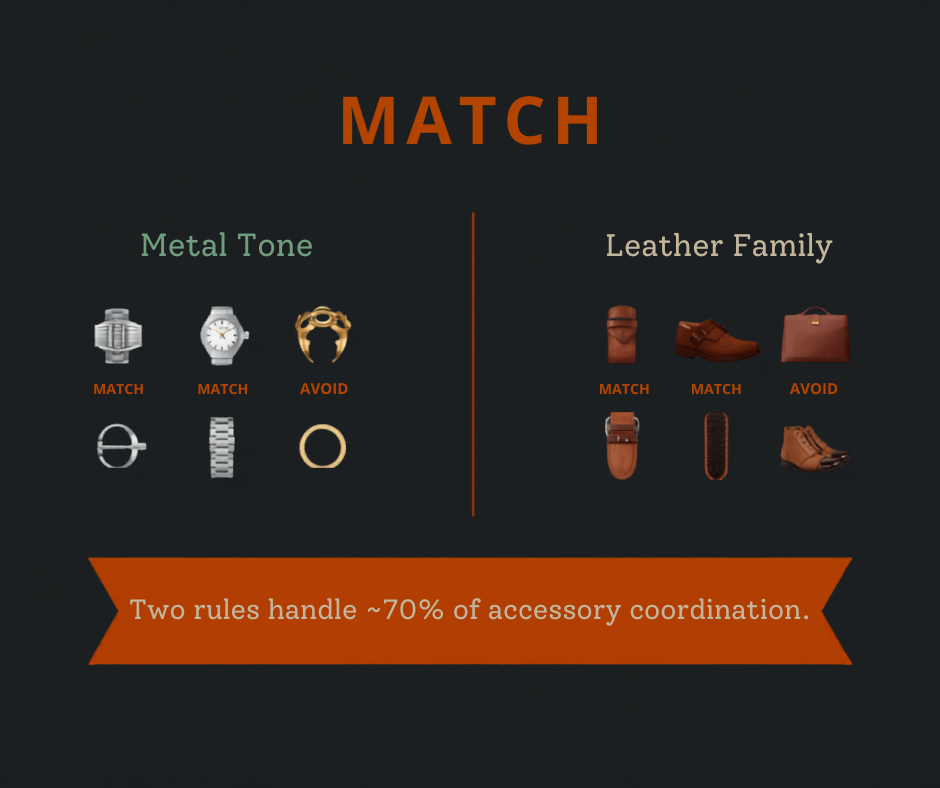
Match your metals. Match your leathers.
That's roughly 70% of accessory coordination. If your watch has a silver case, your belt buckle should be silver. If your shoes are brown, your belt should be brown. Not the exact same shade down to the millimeter, but the same family. A warm tan belt with warm tan shoes. A cool black belt with cool black shoes.
This sounds obvious, but look around any office and you'll see silver watches with gold buckles, black shoes with brown belts, and nobody seems bothered. You will be, once you start noticing.
Belts
A belt holds your pants up and creates a visual bridge between your shirt and trousers. The second job matters more than you'd think.
Width is the first thing to get right. Casual belts run 1.5 to 1.75 inches wide. Dress belts are thinner, around 1 to 1.25 inches. Wearing a thick casual belt with a suit looks off even if you can't say why. The proportions are just wrong.
For buckles, keep it simple. A rectangular or rounded buckle works with everything from chinos to a suit. Anything larger or more decorative reads casual, so save the statement buckles for jeans.
How many do you need? Two. One black dress belt, one brown. If you wear jeans regularly, add a casual brown belt with a wider strap. Three belts handle about 95% of situations, and most men already own at least two of them.
Watches
Watches carry weird weight because they're the one piece of jewelry most men feel comfortable wearing.
The metal tone matters most. Stainless steel is the most versatile. Gold tone reads dressier. Rose gold is harder to coordinate but pairs well with warm-toned outfits. Whatever you pick, it should match your other metals: belt buckle, ring, cufflinks if you wear them.
Here's a trick that's underused: the same watch on a steel bracelet looks business-ready. Swap it to a brown leather strap and it's weekend casual. A NATO strap makes it sporty. If you own one decent watch, buying two extra straps basically gives you three watches for a fraction of the price.
For sizing, case diameter should roughly match your wrist. A 6.5-inch wrist looks good with 38-40mm. A 7.5-inch wrist can handle 42-44mm. Too large looks like a toy strapped to your arm.
Shoes
Shoes are the most expensive accessory and the one people judge first. You can wear a mediocre shirt with great shoes and look put together. The reverse doesn't work.
Formality runs on a spectrum: oxfords (closed lacing) at the top, then derbies (open lacing), loafers, brogues, boots, and sneakers at the bottom. Each step down opens up more casual pairings but closes off formal ones. A pair of dark brown derbies sits right in the middle and handles the widest range, which is why they show up in every "build a wardrobe" article.
Three pairs cover most men. Brown derbies or oxfords for work. Clean white or off-white sneakers for casual. Chelsea or chukka boots for the in-between. That's everything short of a black-tie event.
One thing people underestimate: condition matters more than price. A $100 shoe that's polished, with intact heels, beats a $400 shoe that's scuffed and run down. Maintaining what you have goes further than upgrading.
Socks
Socks are where most men either play it too safe (black, always) or too wild (cartoon characters with a suit).
Your socks should relate to your trousers or your shoes, not your shirt or tie. Navy pants, navy socks. Gray trousers, charcoal socks. This creates a continuous line from hem to shoe that makes your legs look longer, which is a bigger deal than it sounds.
Patterned or colorful socks work when the rest of your outfit is simple. A navy suit, white shirt, and burgundy patterned socks is a nice detail. A checked shirt, striped tie, and polka dot socks is a mess. One statement at a time.
If you're wearing trousers (not jeans), your socks need to be over-the-calf or at minimum mid-calf. No one wants to see a strip of shin when you sit down. This is the one rule with zero exceptions.
Ties
Unless you work in finance or law, you probably only wear ties a few times a year. Which means when you do, you really don't want to get it wrong.
Width should match your lapels. Tie too wide with slim lapels looks dated. Tie too narrow with wide lapels looks borrowed. They should be roughly the same width at their widest point. This is the kind of thing that's invisible when it's right and distracting when it's wrong.
Fabric signals the season. Silk works year-round. Linen and cotton for summer. Wool and knit ties for fall and winter. A knit tie is underrated: it reads more casual than silk, so it works when you want to wear a tie without looking like you're heading to a deposition.
For pattern mixing, the old rule holds: vary the scale. Small checks on the shirt? Go bigger on the tie (wide stripes, larger dots). Same-scale patterns compete. When in doubt, pair a solid tie with a patterned shirt, or the other way around.
Pocket squares
A pocket square is optional, but the bar is so low that just wearing one puts you ahead of 95% of men in the room.
The biggest mistake is matching it to your tie. If your tie is navy with white dots, don't buy a navy pocket square with white dots. Pick up a secondary color from the tie instead, or just go with white linen. White linen works with every suit, every shirt, every occasion. Tuesday meetings, Saturday weddings. Buy one good white linen pocket square and you're set.
You only need to know two folds. The flat fold (a clean rectangle of fabric peeking above the pocket) for business. The puff (stuff it in, let it billow a bit) for everything else. There are YouTube videos showing 47 different folds. Ignore them.
Sunglasses
Sunglasses frame your face, so fit matters more than brand.
The general principle is contrast with your face shape. Round face, angular frames (wayfarers, square). Angular face, rounder frames (aviators, round). If everything matches, you either look soft or severe. Contrast balances things out.
For color, dark tortoiseshell is the brown leather of eyewear: it works with almost everything warm-toned. Black frames are the safe pick for cool-toned outfits. Metal frames should match your watch and belt buckle, same rule as always.
Size is proportional to your face, same as watches to wrists. Frames should be roughly as wide as the widest part of your face. Lenses shouldn't extend below your cheekbone. Too big is a costume, too small is a squint.
Bags
Men's bags have gotten simpler in the last decade. Nobody blinks at a tote or a crossbody anymore, which is nice because pockets only hold so much.
Match the bag's formality to your outfit. Briefcase or structured leather with business clothes. Canvas tote or messenger with casual clothes. Backpack for outdoors or truly casual days. A leather briefcase paired with jeans and sneakers looks like you forgot to change after work.
Leather color rules carry over from shoes and belts. Your bag should be in the same color family. A black leather bag with brown shoes is going to look off. If you're only buying one bag, go brown. It's more flexible.
And spend a bit more on one good bag rather than cycling through cheap ones. Well-made leather actually looks better as it ages. A cheap bag looks like a cheap bag from day one and falls apart within months.
Putting it all together
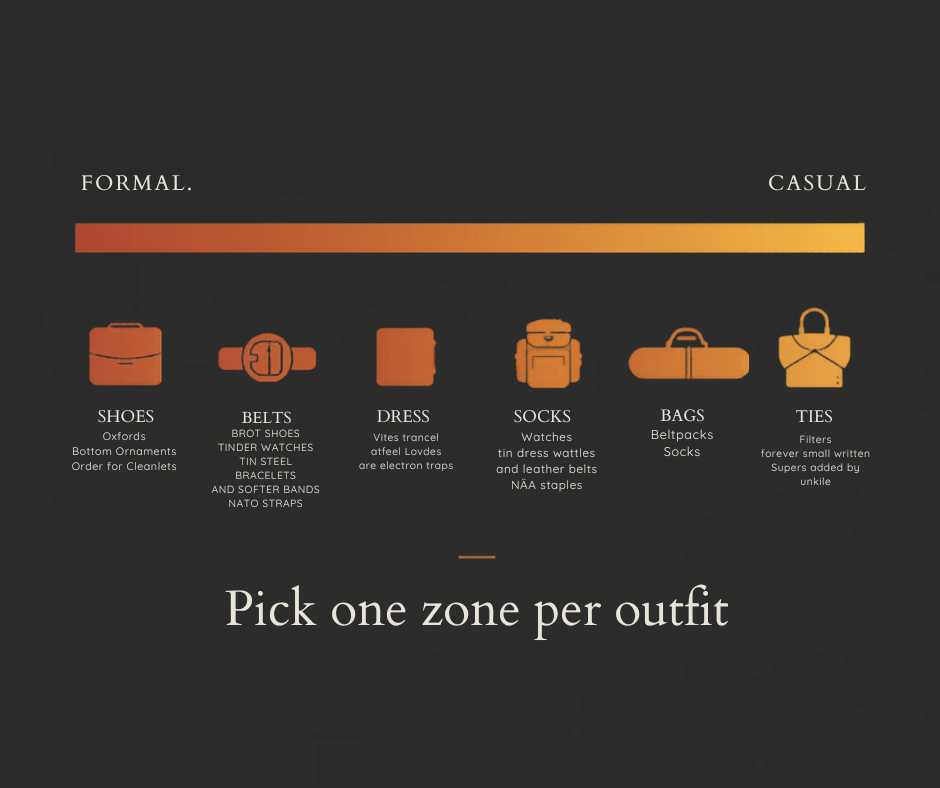
When you're getting dressed, you're really only making three accessory decisions. What metal tone are you wearing? Silver or gold, consistent across your watch, buckle, and any other hardware. What leather family? Black or brown, consistent across shoes, belt, bag, and watch strap. And what's the formality level? Everything should sit in the same rough zone, from casual to dressy.
Get those three things lined up and you'll look coordinated even if the individual pieces aren't expensive. That's the whole trick. There isn't really one beyond this.
© 2026 Outfii. All rights reserved. This article is original content by Outfii Team. Republishing or redistribution without written permission is prohibited. Excerpts and links may be used, provided full credit is given to Outfii with a link back to the original article.
Ready to transform your wardrobe?
Outfii uses AI to help you organize, style, and make the most of every piece you own.
Download the App