The Math Behind a 30-Piece Wardrobe
Susie Faux coined "capsule wardrobe" back in the 1970s. The idea seems simple enough: own fewer, better clothes that all coordinate. But here's what nobody really explains: why it actually works. And more importantly, how to pick 30 items that generate hundreds of outfits instead of a dozen.
A poorly curated 30-piece wardrobe might yield 15 outfits. A smart one? 200 or more. The gap isn't about taste. It's math.
Slots: the building blocks
Think of an outfit as a series of slots that need to be filled. Bare minimum: top and bottom, or a full dress. Then add shoes. Outerwear and accessories are optional, but they're where things get interesting.
Here's how it breaks down:
Top — shirts, blouses, tees, sweaters, tanks. Anything that covers your chest.
Bottom — trousers, jeans, skirts, shorts.
Full body — dresses, jumpsuits, rompers. Covers both slots at once.
Shoes — pretty obvious, but matters for the math.
Outerwear — jackets, coats, blazers, cardigans.
Accessories — scarves, bags, hats, jewelry. Usually optional, but they change everything.
A basic outfit uses 3 slots: top + bottom + shoes. Say you have 10 tops, 5 bottoms, and 4 pairs of shoes. That's 10 × 5 × 4 = 200 combinations. Add 3 jackets, and you hit 200 × (3 + 1) = 800 (the "+1" because sometimes you wear no jacket).
This is the whole point: each new piece multiplies your options instead of just adding to them. The 31st item in a good capsule creates way more new outfits than the 31st item crammed into an overstuffed closet full of one-hit wonders.
Not all 200 combinations work
Here's where reality hits: that math assumes every combo is actually wearable. It's not.
A neon yellow top might only work with 2 of your 5 bottoms. Formal pencil skirt? Pairs with maybe 4 tops. Those statement shoes sit in limbo, only living in specific outfits. Your actual number of good outfits depends on whether the pieces actually work together.
This is where color theory matters. And formality bandwidth. And pattern sense.
The color coverage strategy
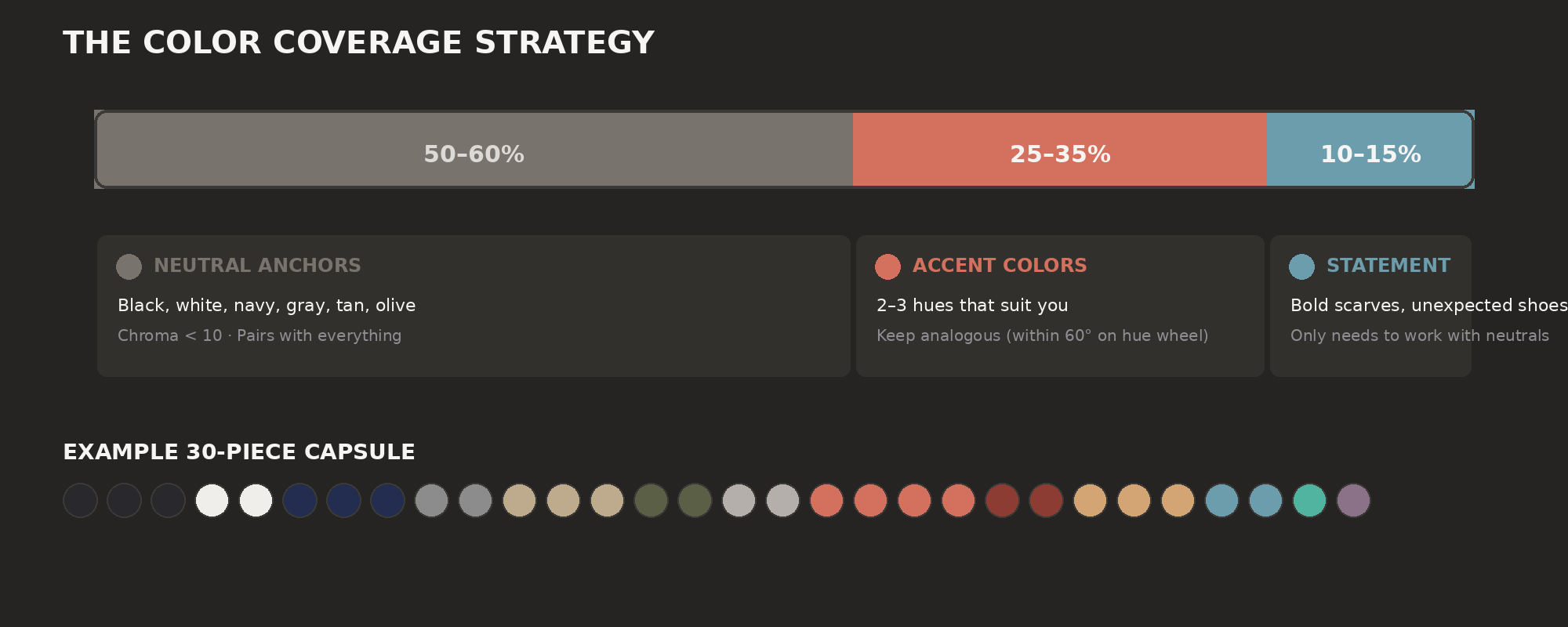
Your colors need to do two things: anchor everything, and then spice it up.
Neutral anchors (50–60%). Black, white, navy, gray, tan, olive. Low chroma colors (below 10 in color science). They pair with literally everything because they don't fight other hues. These are your workhorses.
Accent colors (25–35%). Pick 2–3 colors you actually look good in. Warm undertone? Burnt orange, olive, burgundy. Cool? Navy, dusty rose, slate blue. Keep them roughly analogous (within 60° on the hue wheel).
Statement pieces (10–15%). One or two wild cards. A bright scarf, unexpected shoe color, a complementary pop. These aren't meant to pair with everything — they just need to work with your neutrals and maybe one accent.
So 18 well-chosen neutral/accent pieces that all go together, plus 3 statement pieces that pair with most of what you own? Way more wearable outfits than 30 unrelated pieces.
Formality bandwidth
The classic mistake: 30 items that are all equally casual. Ten tees, seven jeans, basic sneakers. Comfortable? Sure. But then you need something for a dinner date or a meeting and you've got nothing.
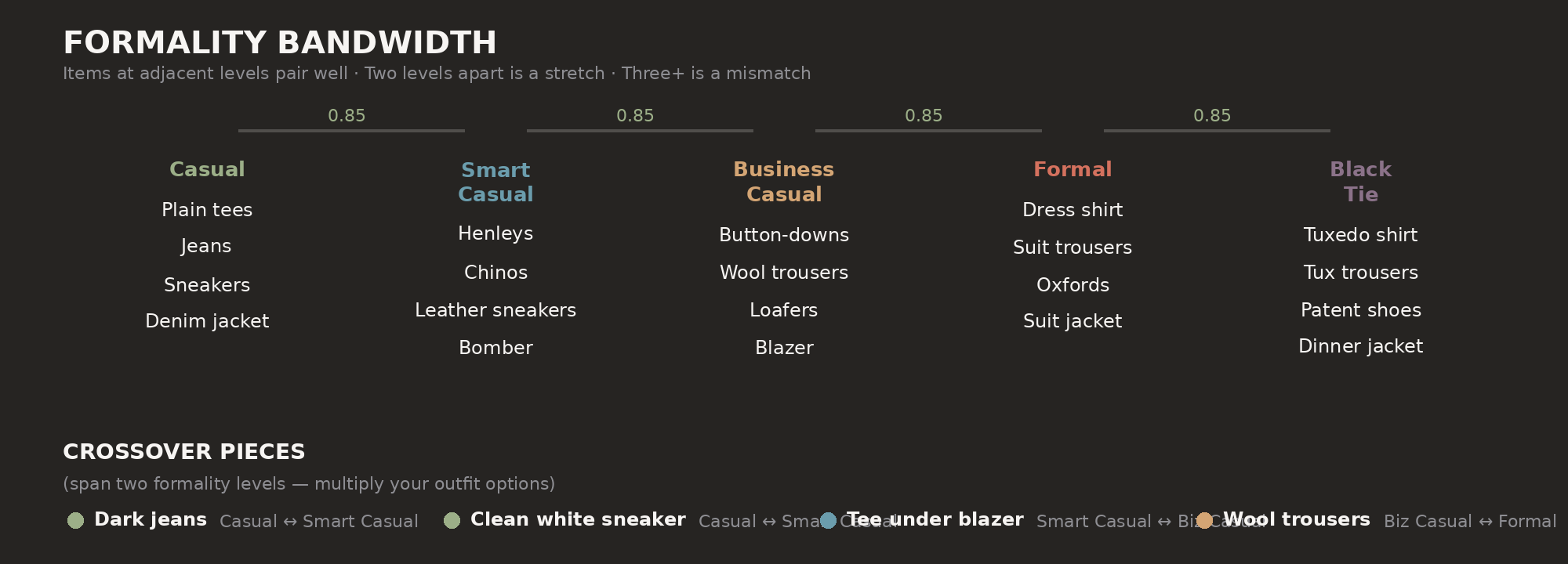
A real capsule spans 2–3 formality levels. Think of it like this: Casual sits next to Smart Casual. Smart Casual sits next to Business Casual. Items one level apart pair naturally (they score well together). Two levels apart is awkward. Three levels and you've got a problem.
For most people, Casual through Business Casual is enough. So maybe:
- Casual: plain tees, jeans, sneakers, denim jacket
- Smart Casual: henleys, chinos, leather sneakers, bomber
- Business Casual: button-downs, wool trousers, loafers, blazer
But here's where it gets smart: crossover pieces. Dark jeans that don't read as pure casual. A good tee that doesn't look sloppy under a blazer. A white sneaker that works almost anywhere. These pieces suddenly double the outfits that "work."
The pattern budget
Most capsule advice says "solids only." Practical? Yes. Boring? Also yes. Better idea: budget for patterns.
One pattern per outfit works fine. Two patterns from different families (a stripe and a floral, say) can work if they're at different scales. Beyond that, you're experimenting.
In a 30-piece wardrobe, aim for 5–8 patterned pieces:
- 2–3 patterned tops (striped shirt, floral blouse, plaid flannel)
- 1–2 patterned bottoms (plaid trouser, printed skirt)
- 1 patterned layer (checked coat, patterned blazer)
- 1 patterned accessory (scarf, bag)
One rule: patterns from different families. Two stripes? They fight each other. A stripe and a floral? They're actually fine together because the eye processes them differently.
Seasonal rotation
If you actually have seasons, a static 30-piece wardrobe doesn't survive winter to summer. The fix is a rotating capsule: about 15 pieces that stay year-round, 15 that swap out.
Permanent core: neutrals, year-round shoes, transitional layers. Rotating: shorts and linen in summer, wool and coats in winter.
Here's where tracking helps. Without it, you close out winter and forget what you stashed. Come October, you pull out that sweater and can't remember if it still fits. You end up buying a third navy sweater when you already have two.
Even rough wardrobe logging changes this. You know what you own, what condition it's in, what you actually lack.
The cost-per-wear calculation
People pitch capsule wardrobes as money-saving. That's true, sort of. If you buy 30 cheap pieces and wear each 5 times, you're spending the same per-wear as someone who bought 100 items and wore each 1.5 times. The real win isn't cheaper — it's intentional.
What matters: cost per wear. $200 boots worn 150 times? $1.33 per wear. $30 shoes worn 5 times? $6 per wear. A capsule naturally pushes you toward the first scenario: fewer pieces, chosen well, worn a lot.
Wear tracking makes this click. When you see that your $40 fast-fashion jacket's been worn twice in six months while your $180 wool coat comes out every other day, buying gets easier.
Building your capsule: a practical sequence
Starting from scratch is daunting. Here's a five-step approach:
1. Audit what you own. Photograph everything. Sort by slot, color, formality, pattern. You'll probably find you have way too many tops and basically no shoes. Normal.
2. Find your keepers. What do you actually grab? If you track wear, it's obvious. If not, pick the pieces you've touched in the last month.
3. Map the gaps. Take your keepers. Do you have 8 tops but 2 bottoms? You need bottoms. All your stuff in blue and gray? A warm accent color changes everything.
4. Buy the gaps. This is the only time you shop. One neutral bottom. One shoe that bridges formality levels. One accent color that doesn't clash.
5. Check in quarterly. A capsule isn't set-and-forget. Every few months, look at what's actually getting worn and what's dead weight. It evolves.
The real point
Thirty pieces isn't the goal. It's a forcing function. The limit makes you think about how things relate instead of seeing each piece as its own thing. It makes you weigh color, formality, pattern, slots. The stuff that determines if an outfit actually works.
You don't need exactly 30. Some people hit 20. Others go to 50. The number's less important than the logic: every piece should multiply your options, not just pad the closet.
Want to audit your wardrobe and see which items are pulling their weight? Download Outfii and start building smarter.
© 2026 Outfii. All rights reserved. This article is original content by Outfii Team. Republishing or redistribution without written permission is prohibited. Excerpts and links may be used, provided full credit is given to Outfii with a link back to the original article.
Ready to transform your wardrobe?
Outfii uses AI to help you organize, style, and make the most of every piece you own.
Download the App